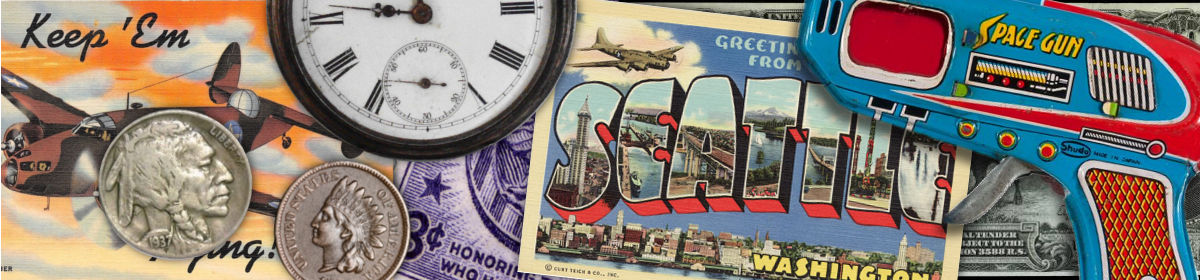
What is it that makes the Pacific Northwest a little wild, a little woolly . . . and sometimes downright creepy?
The first time I ever visited Seattle, in 1992, I went into a T-shirt shop to buy souvenirs and struck up a conversation with the salesgirl and another customer, both Puget Sound natives. Being from out of the area, I asked what Washington State was like, and for some reason the conversation drifted to serial killers. The other customer remarked that (at that time) Washington supposedly had a higher percentage of serial murderers than any of the other 49 states. When I asked why, he cited factors that seemed to be conducive to such calculated savagery: the rain, the many heavily wooded, unpopulated areas, and the idea that it’s more “socially acceptable” to be a loner in the Northwest than elsewhere.
But I didn’t intend to cast a pall on your day: This is not another story about crime. I just noted that today’s New York Times reports that the U.S. Forest Service has “quietly released” records about another (sort of) scary Northwest phenomenon: that large, hairy walking cliché we know as Bigfoot, Sasquatch (from a Salishan term for “wild man”), and Skookum (another Salishan term, translated as “mountain giant” or “mountain devil”—although in the Chinook language it can be an adjective with such nice connotations as “big,” “strong,” “dependable,” and “hardworking,” like Mr. Clean or Fess Parker, star of the 1950s TV series Davy Crockett).
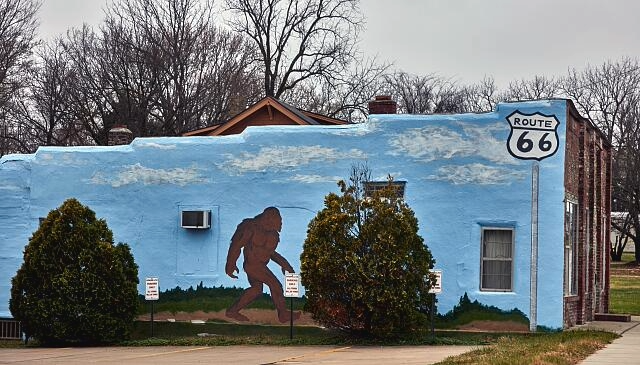
“We are everywhere!” A Sasquatch mural on Route 66 in Springfield, Missouri. Artist unknown. Photo by Carol M. Highsmith, 2020. Library of Congress Prints and Photographs Division, call no. LC-DIG-highsm-64324.
It’s easy for us world-weary twenty-first-century internet travelers to call the Sasquatch stories a lot of bunkum (which is NOT a Salishan word), although the Indian legends may go back millennia, and reported sightings by white people—starting with fur traders in British Columbia in the 1880s—are certainly reliable if it could ever be proven that the eyewitnesses weren’t drunk and/or desperately in need of company, if you know what I mean.
And yet, Bigfoot is not a strictly Northwest phenomenon. Although one of the more prominent Sasquatch websites—the Bigfoot Field Researchers Organization, or BFRO (www.bfro.net)—lists a majority of the nation’s historical sightings taking place in Washington State (followed by California, Florida, and Ohio, oddly enough), both the Sasquatch Information Society (www.bigfootinfo.org) and the North American Wood Ape Conservancy (www.woodape.org) indicate that Texas is now the big “hotspot” in terms of number of Bigfoot reports. (Expect more of that once the Lone Star State legalizes weed.)
Did the hunters and trappers and trekkers and picnickers really spot the spirits of Native American lore in those dripping Northwest forests . . . ?
Forgive me for being mildly cynical: Consider what happened with Roswell and so many other cockamamie UFO incidents. Those people all claimed they knew what they had witnessed, with conspiracy theorists claiming that the government was covering up close encounters of the third kind (and not JFK’s or Bill Clinton’s). Meanwhile, the more skeptical among us—including myself, in uneasy company with conspiracy theorists on the other end of the spectrum—believed that there was nothing extraterrestrial about flying saucers. We were still fighting the Cold War, weren’t we? No doubt, the Pentagon was up to something and concealing it, for obvious reasons.
Turns out we were all right, to a greater or lesser degree: Most of the documented sightings of flying saucers were real—they just weren’t alien craft—and the military did have something under wraps all those years. During World War II, the Nazis had been experimenting with the aeronautical possibilities of flying discs and flying wings. In the spring of 1945, as the Third Reich burned, U.S. forces grabbed as many German weapons scientists and as much of their research as possible before the Soviets could; then our scientists picked up the ball (or the Frisbee, as it were) and secretly ran with it for several decades. Behold: the stealth bomber.
Getting back to Bigfoot: Did the hunters and trappers and trekkers and picnickers really spot the spirits of Native American lore in those dripping Northwest forests, or were they really the spirits in a bottle of Seagram’s Seven Crown—figments of the overactive imaginations of white people? Were they sightings of a true biological missing link—a human subspecies that refused to go extinct—or just fleeting glimpses of old hippies who decided to live “off the grid” by homesteading in the woods? And is the correct plural “Bigfeet” or “Bigfoots”?
We may never know for certain . . .