Welcome to the first of a new feature here on Northwest Collector: Dealer’s Special Pick, in which an interesting item of my choosing in a collectibles dealer’s inventory is showcased!
Our first dealer is Kol Shaver of Zephyr Used and Rare Books (http://www.zephyrusedandrarebooks.com), located in Vancouver, Washington, here in the Pacific Northwest. Kol got into the rare book business in 1987 while at UCLA, where he was in the PhD program in medieval history with an emphasis in the history of science. He got a job at Rootenberg Rare Books & Manuscripts (https://www.rootenbergbooks.com/), specializing in the sciences and medicine. He worked for Rootenberg until 1994, then started his own business.
He issues ten to twelve catalogs a year, exhibits in six or seven shows annually, and is a member of the Antiquarian Booksellers Association of America (https://www.abaa.org/).

I asked Kol what he specializes in; he answered, “I’m definitely a polymath, as anyone looking at my catalogs can see. I tend to focus on pre–World War II for the most part, with a heavy emphasis on nineteenth- and twentieth-century illustrated books, technology, trade catalogs, sample catalogs, photographs, photography, Western Americana, Pacific Northwest history, world’s fairs, children’s books, mysteries and science fiction in dust jackets, and archives as well.”
I also asked Kol what kind of material he’s looking to purchase. He said, “I usually send people my catalogues and say that if they have items in those veins, then I’m interested. Often, though, I just flat-out need to see them. A key issue for me is condition. I often have people looking to sell me material and state that ‘it’s pretty good for its age.’ I always reply, ‘I’m looking for material that’s as close to what it would look like if you went into the store in 1880 to buy it.’ It should be clean and crisp, as projects are always a hassle to have repaired.”
Looking through Kol’s really excellent December 2025 catalog (https://drive.google.com/file/d/1YSzSro5JZWE4NWP3CDd24yQ7oh10iLBW/view), I was especially attracted to a portfolio of British ferns, which reminded me of other British trends of centuries past, like having a resident hermit on your estate, or creating “phantom bouquets” of skeletonized flowers. Here’s the description of the item, which is still available as of this writing:
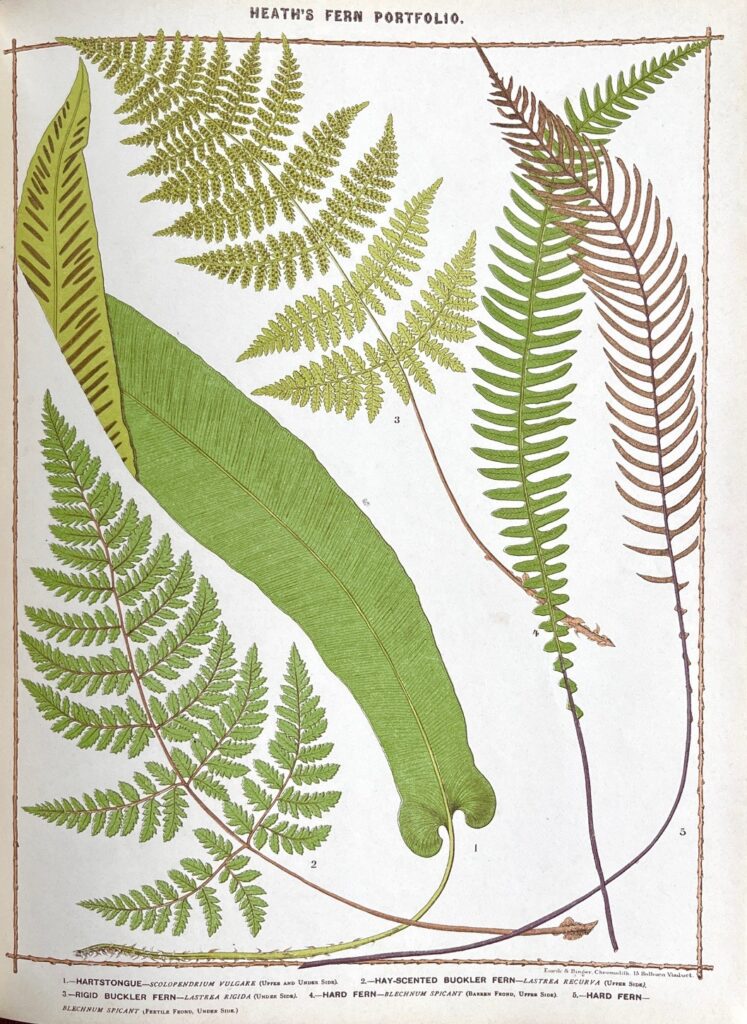
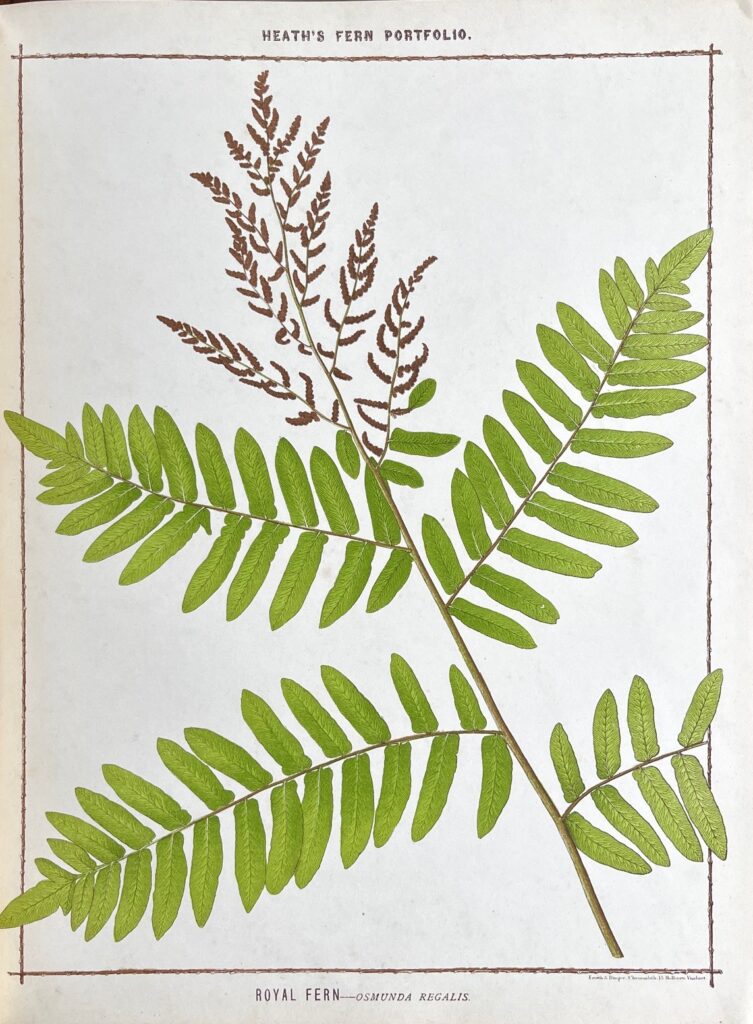
63673 [BOTANY — CHROMOLITHOGRAPHS]. HEATH, Francis George. The fern portfolio: all the species of British ferns are included in this volume. . . . London: Society for Promoting Christian Knowledge, [Emrik & Binger, Chromolithographers, 15, Holborn Viaduct], 1885. Folio. 12 x 15.5 in. [38 pp (unpaginated).] With 15 chromolithograph colour plates, each with facing text leaf. Olive-green pictorial publisher’s cloth, gilt decorative lettering front cover, British ferns depicted in green & black, decorative endpapers (minor edgewear, minor bumping to corners, head & foot of spine, slight occasional foxing), still a VG– bright copy. $750.00
First edition of this wonderful production by the noted British botanist, designed to depict all British fern varieties in nearly life-size formats through the chromolithography of Emrik & Binger. This was designed to serve as a key visual reference for the legions of specimen and herbarium collectors during the Victorian fern rage, or Pteridomania, where enthusiastic and often zealous collectors during the last half of the 19th Century filled ferneries, created fern cabinets, and herbariums. Ferns varieties illustrated within encompass Royal Fern, Broad Buckler Fern, Hartstongue, Mountain Buckler Fern, Holy Fern, Brittle Bladder Fern, and many others.
Heath (1843–1913) was a noted British botanist, civil servant, editor of Gilpin’s Forest Scenery, and a pioneering force in the Open space and Green Belt movements across Victorian England. Emrik & Binger produced chromolithographs & lithographs for very few British & European illustrated works, and are not included in Twyman’s A History of Chromolithography.
All images courtesy of Kol Shaver, Zephyr Used and Rare Books.
Will you be in the San Francisco area between February 27 and March 1? Visit the 57th California International Antiquarian Book Fair. See https://www.abaa.org/events/57th-california-international-antiquarian-book-fair for details!