I’ve been planning to feature Gene Baade for a long time—not only because his business, Books on the West (www.booksonthewest.com), specializes in nonfiction books on the American and Canadian West (subjects I’m especially interested in, as regular readers of this blog may have gathered) but also because he’s located here in the Pacific Northwest, in Renton, Washington.
Gene has also established a niche in one of his favorite interests, Sasquatch, aka Bigfoot, and has published a critical bibliography on that subject, along with a number of articles. However, his inventory includes theology, modern first editions, and books in other fields.
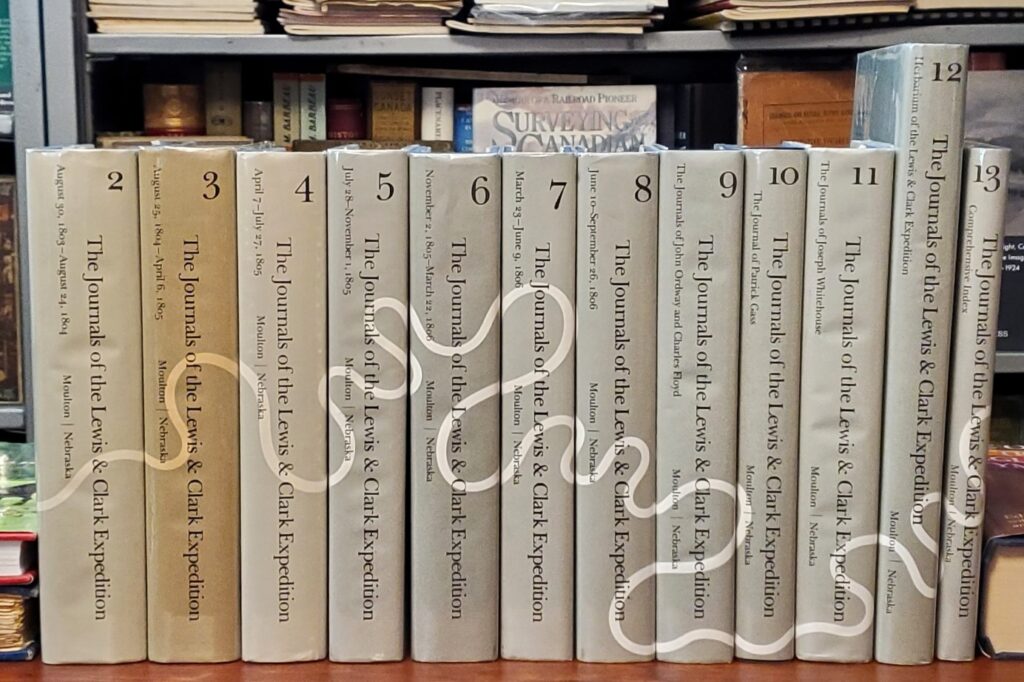
The complete set of The Journals of the Lewis and Clark Expedition, published by the University of Nebraska Press from 1983 to 2001, includes the atlas, seen below.
Originally from rural Garfield County in northern Oklahoma—he grew up six miles from the Old Chisholm Trail!—Gene graduated from OSU and taught U.S. history at a high school in Oklahoma City but felt the calling to enter the ministry. He earned theological degrees from Concordia Theological Seminary in Illinois and Valparaiso University in Indiana, including a yearlong pastoral internship at the University of British Columbia’s Lutheran Campus Centre. (He was ordained in 1971.) During that time, and newly married, Gene and his wife, Joyce, traveled to the Canadian Rockies three times, sparking his deep interest in western Canadian history.
After Gene’s ordination, the Baades started a family in the Northwoods city of Rhinelander, Wisconsin, where Gene ministered to two congregations (in the city and the country) over fifteen years, then moved to Portland, Oregon, in 1986 when he was called to serve a congregation there. It was in Portland that he got started in the rare book business.
“Bookselling has always taken a back seat to the responsibilities of the ministry.” —Gene Baade
“I began to buy books at Powell’s, the Great Northwest Bookstore, and Preston McMann’s Old Oregon Bookstore,” Gene told me. “While visiting another shop, I purchased for a measly $15 a rare book on the James brothers outlaws published in Swedish. After that, a major outlaw collector in Texas freely offered me a huge mailing list of collectors and libraries to help me get started selling books more extensively.” (Gene gave the collector the James book as a token of his gratitude.) In 1988 he started mailing out simple catalogues printed at Costco and collated by his family. Nowadays he produces digital catalogues of Old West books two or three times a year, limited to about fifty titles each.
When I asked Gene what he’s interested in purchasing, he replied, “I’m doing only a small amount of buying at this stage of my life, but I cannot resist making purchases either for inventory or my personal library”—a familiar defense by those of us of a certain age. “I’m drawn to hard-to-find Old West books and ephemera, scarce Bigfoot books, Western Canadiana—specifically the Canadian Pacific Railroad and the Canadian Rockies—and British Columbia,” he noted, adding, “Also, unusual material on my home state of Oklahoma.”
Gene is a member of the Independent Online Booksellers Association, the Pacific Northwest Booksellers Association, the Book Club of Washington, the Wild West Historical Association, and the Oklahoma Historical Society.
He does not exhibit at book fairs because he still leads worship every Sunday at a small Lutheran congregation on Mercer Island, Washington. “Bookselling has always taken a back seat to the responsibilities of the holy ministry,” he said.
When I asked Gene about a special item he has on offer, he suggested the following set, which will no doubt be of interest to Lewis and Clark enthusiasts:
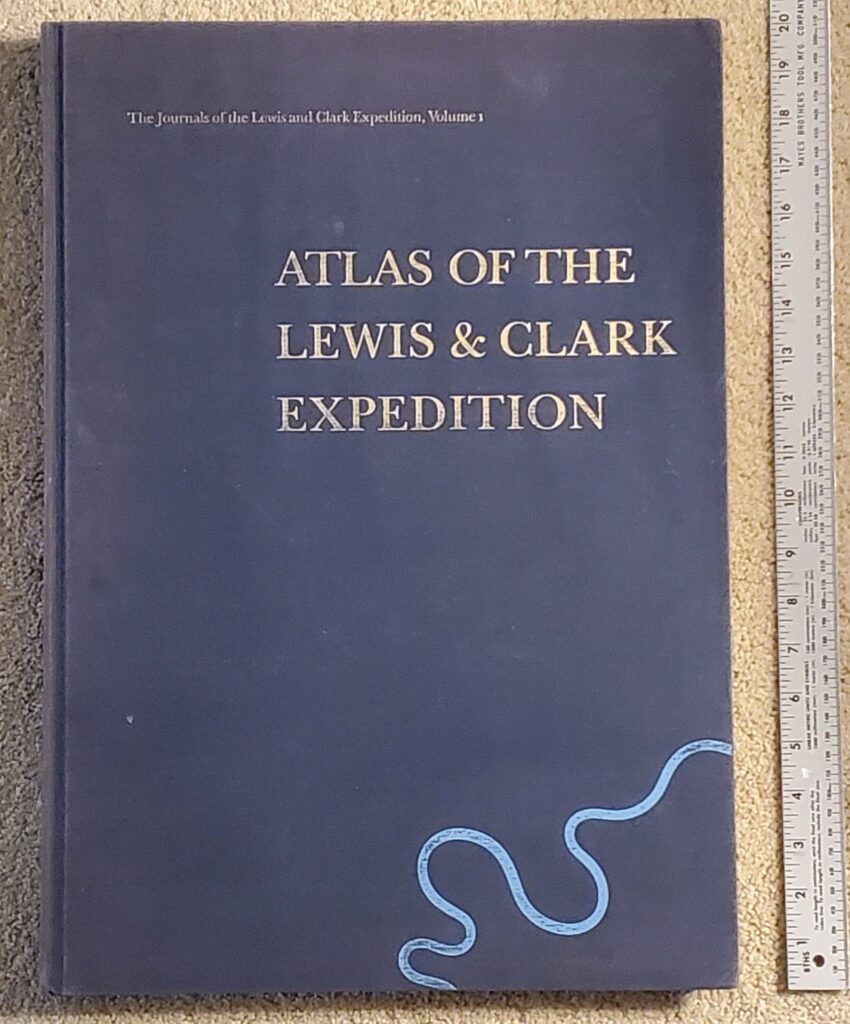
Lewis, Meriwether, and Clark, William. The Journals of the Lewis and Clark Expedition. Ed. Gary Moulton. Lincoln: University of Nebraska Press, 1983–2001. First editions. Thirteen volumes, volume 1 being the folio atlas published without a dust jacket. Eleven of the other twelve volumes in large octavo, volume 13 being the set Index. Volume 12 is the herbarium volume with black-and-white reproductions of the “more than 200 pressed and dried plant specimens gathered by” the expedition (actually 239). This volume larger than the others. Aside from the atlas, the other twelve volumes are fine in fine dust jackets. The atlas is very good, with minimal fading and also minimal fading to the spine, which is often the victim of sunshine. The atlas is a presentation copy inscribed by Moulton to Samuel Davis III. This edition is critically edited by Moulton and the press. Other than the original two-volume 1814 edition of the journals, this is the quintessential edition and is now scarce in fine condition first editions. $1,500.